


 October 1, 2026
Understanding academic scores can become confusing when your marksheet shows CGPA but a university, scholarship provider, or application form asks for a percentage. This is where a CGPA to Percentage Converter can make the process much easier.
Instead of manually working through calculations, students can use a converter to estimate their percentage within seconds. However, there is one important point to remember: not every school, board, college, or university uses the same CGPA-to-percentage formula.
This guide explains what CGPA means, how CGPA is converted into percentage, commonly used formulas, practical examples, and how students can avoid mistakes while preparing academic or study-abroad applications.
Table of Contents
- Meaning of CGPA
- What Is a CGPA to Percentage Converter?
- How to Convert CGPA into Percentage ?
- What Is the CGPA to Percentage Formula?
- How Does a CGPA to Percentage Calculator Work?
- CGPA to Percentage Conversion Table
- What Are the Benefits of Using the CGPA to Percentage Converter?
- Why Students Need a CGPA to Percentage Converter
- Where Is CGPA to Percentage Conversion Used?
- How to Calculate Percentage from CGPA Without a Calculator
- Example of CGPA to Percentage Converter
- Why Choose Jupiter Consultant for Study Abroad Guidance?
- Frequently Asked Questions About CGPA to Percentage Converter
- Conclusion
Meaning of CGPA
CGPA stands for Cumulative Grade Point Average. It represents a student’s overall academic performance across multiple subjects, semesters, or academic periods.
Instead of displaying performance directly as a percentage, many educational institutions use grading scales such as:
- 10-point CGPA scale
- 4-point GPA scale
- Letter-grade system
- Institution-specific grading scales
For example, a student may have a CGPA of 8.4 out of 10 instead of receiving a result expressed directly as 79% or 80%.
CGPA makes it easier to summarize overall academic performance, but conversion may become necessary when another institution requests percentage-based marks.
What Is a CGPA to Percentage Converter?
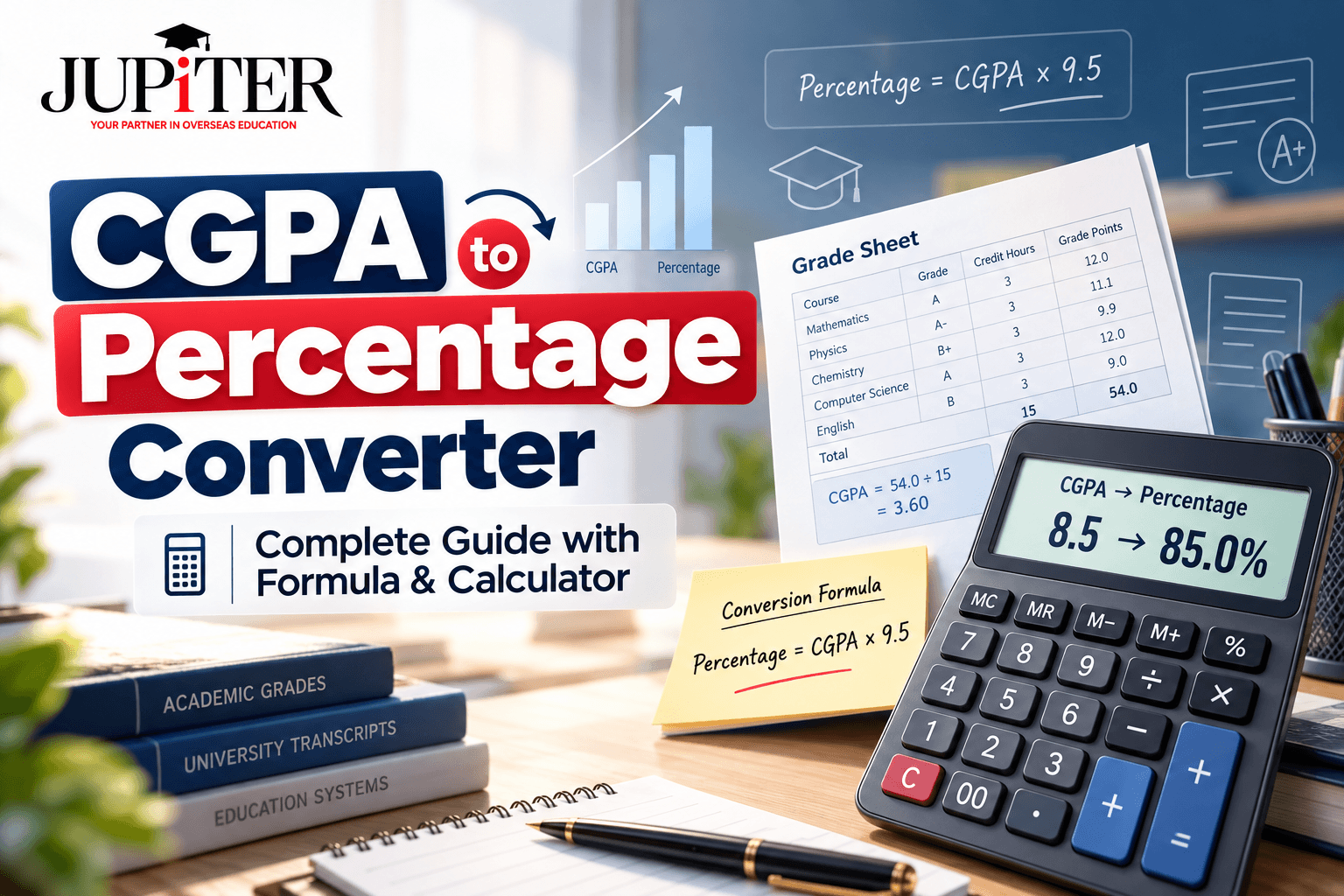
A CGPA to Percentage Converter is a tool that helps students convert their Cumulative Grade Point Average into an estimated percentage using an applicable conversion formula.
For example, where the formula CGPA × 9.5 applies, a CGPA of 8.0 would convert to:
8.0 × 9.5 = 76%
this formula should not automatically be used for every institution. Students should always check the official conversion method mentioned by their school, university, board, or academic authority.
How to Convert CGPA into Percentage ?
To convert your Cumulative Grade Point Average (CGPA) to a percentage, multiply your CGPA by the standard CBSE CGPA to Percentage Calculator multiplier of 9.5
The process depends on the conversion formula prescribed by your institution.
A commonly referenced method is:
Percentage = CGPA × 9.5
For example:
If your CGPA is 8.2:
8.2 × 9.5 = 77.9%
Therefore, the estimated percentage would be 77.9% where the 9.5 conversion rule applies.
Steps to Convert CGPA into Percentage
- Check your final or cumulative CGPA.
- Find your institution’s official conversion formula.
- Enter the CGPA into a CGPA to Percentage Converter or calculate it manually.
- Apply the prescribed multiplication factor or formula.
- Verify the result before using it in an official application.
Never assume that multiplying by 9.5 is appropriate simply because it appears frequently online.
What Is the CGPA to Percentage Formula?
One of the commonly used formulas is:
Percentage = CGPA × 9.5
Few Examples for CGPA to Percentage
- 6 CGPA × 9.5 = 57%
- 7 CGPA × 9.5 = 66.5%
- 8 CGPA × 9.5 = 76%
- 9 CGPA × 9.5 = 85.5%
- 10 CGPA × 9.5 = 95%
These calculations are useful for understanding how the formula works, but your official percentage may differ if your educational institution follows another method.
Some universities provide their own equivalence formulas or conversion certificates. In such cases, the university’s official method should take priority over a general online calculator.
How Does a CGPA to Percentage Calculator Work?
A CGPA to Percentage Calculator takes your CGPA and applies a selected conversion formula to provide an estimated percentage.
The process is generally simple:
Step 1: Enter Your CGPA
Enter your cumulative grade point, such as 7.8, 8.2, or 9.1.
Step 2: Check the Grading System
Determine whether your institution uses a 10-point scale or another grading system.
Step 3: Select the Correct Formula
Use the conversion formula officially recommended by your institution.
Step 4: Calculate the Result
The calculator applies the formula and displays the corresponding percentage.
A CGPA to Percentage Converter can save time, particularly when students are comparing eligibility criteria for several courses or universities.
CGPA to Percentage Conversion Table
The following table shows sample conversions using the CGPA × 9.5 formula.
| CGPA | Percentage |
| 10.0 | 95% |
| 9.5 | 90.25% |
| 9.0 | 85.5% |
| 8.5 | 80.75% |
| 8.0 | 76% |
| 7.5 | 71.25% |
| 7.0 | 66.5% |
| 6.5 | 61.75% |
| 6.0 | 57% |
| 5.5 | 52.25% |
Important: This conversion table is only applicable where the 9.5 method is accepted. Check your institution’s official grading and conversion policy before submitting a percentage.
What Are the Benefits of Using the CGPA to Percentage Converter?
Using a CGPA to Percentage Converter can help students quickly understand their academic scores without repeatedly performing manual calculations.
Key benefits include:
- Quick calculation: Get an estimated percentage within seconds.
- Easy to use: No complicated mathematical calculations are required.
- Useful for applications: Helps when reviewing college, scholarship, or course eligibility.
- Reduces calculation errors: Automated calculations can prevent basic multiplication mistakes.
- Better academic comparison: Makes it easier to understand percentage-based requirements.
- Convenient for students: Useful when comparing multiple programs or admission criteria.
The converter should still be treated as a calculation tool rather than a replacement for an institution’s official academic documentation.
Why Students Need a CGPA to Percentage Converter
Imagine a student with an 8.4 CGPA applying for a university program that lists a minimum eligibility requirement of 75%.
If the student’s institution officially uses the 9.5 formula:
8.4 × 9.5 = 79.8%
The student can quickly see that their estimated percentage is 79.8%.
This is particularly helpful when researching several universities. Instead of trying to interpret CGPA against percentage-based admission requirements every time, students can use a CGPA to Percentage Converter for an initial comparison.
However, before submitting the application, the student should verify whether the destination university accepts the converted figure and whether an official conversion document is required.
Where Is CGPA to Percentage Conversion Used?
CGPA conversion may be useful in several academic and professional situations.
1. University Admissions
Some universities state entry requirements as percentages, even when applicants receive grades in CGPA format.
2. Study Abroad Applications
International institutions may use grading systems different from those used by a student’s home institution.
3. Scholarship Applications
Scholarships sometimes specify a minimum percentage or equivalent academic score.
4. Job Applications
Some employers request academic marks as percentages during recruitment.
5. Competitive and Government Examinations
Application forms may require candidates to enter percentage marks rather than CGPA.
6. Academic Documentation
Students may need percentage equivalence for credential evaluation or document verification.
If you are preparing an international education application, Jupiter Consultant can help you understand admission requirements and the documents requested by your selected institution.
How to Calculate Percentage from CGPA Without a Calculator
If the applicable formula is CGPA × 9.5, you can calculate the percentage manually.
Suppose your CGPA is 7.6.
Step 1: Write down your CGPA: 7.6
Step 2: Multiply it by 9.5.
Step 3: 7.6 × 9.5 = 72.2
Result: 72.2%
The calculation itself is simple, but selecting the correct formula is more important than the mathematics.
Before converting your score, look for an official formula on your marksheet, transcript, university website, grading-policy document, or academic handbook.
Example of CGPA to Percentage Converter
Consider a student named Riya who has received an 8.7 CGPA and wants to check her approximate percentage before researching postgraduate study options.
If her institution confirms that the 9.5 formula applies:
8.7 × 9.5 = 82.65%
Her converted score would therefore be 82.65%.
She can use this figure for preliminary course research. But if a university requests an official percentage equivalence, she should submit the conversion prescribed or certified by her institution instead of relying solely on an online calculator.
This distinction is important because an incorrect conversion can create unnecessary confusion during an admission or document-review process.
Why Choose Jupiter Consultant for Study Abroad Guidance?
Converting your CGPA is often only the first step. Students may also need to understand course eligibility, admission requirements, documentation, application processes, and other university-specific conditions.
Jupiter Consultant helps students navigate these requirements with clearer, more structured guidance.
Students can seek support with areas such as:
- University and course selection
- Admission requirement guidance
- Academic document preparation
- Application support
- Study-abroad planning
- Understanding institution-specific eligibility requirements
Rather than relying only on a generic CGPA to Percentage Converter, students preparing an international application should also confirm how their chosen university evaluates grades.
Jupiter Consultant can help students review these requirements before they move ahead with their applications.
Frequently Asked Questions About CGPA to Percentage Converter
What is the easiest way to convert CGPA into percentage?
The easiest method is to use a CGPA to Percentage Converter with the official conversion formula prescribed by your institution. If your institution uses CGPA × 9.5, simply multiply your CGPA by 9.5.
Is CGPA multiplied by 9.5 always correct?
No. The CGPA × 9.5 method is not a universal formula. Schools, universities, boards, and other institutions may use different methods.
What is 8 CGPA in percentage?
Using the CGPA × 9.5 formula: { 8 × 9.5 = 76% }
What is 9 CGPA in percentage?
Using the same formula: { 9 × 9.5 = 85.5% }
Can I use an online CGPA converter for university applications?
You can use a CGPA to Percentage Converter for estimation, but official applications should follow the grading or conversion requirements specified by the university or your awarding institution.
Is CGPA the same as percentage?
No. CGPA is a grade-point-based representation of academic performance, while percentage expresses marks on a scale of 100.
How can I find my university's official conversion formula?
Check your official transcript, marksheet, academic regulations, university website, examination department, or registrar's office. If no formula is available, ask the institution directly instead of assuming a conversion method.
Conclusion
A CGPA to Percentage Converter is a convenient way to understand how a grade point may translate into percentage terms. It is especially useful when reviewing university eligibility, scholarship requirements, employment criteria, or study-abroad opportunities.
The most important rule is simple: always use the conversion formula officially accepted by your institution. The commonly used CGPA × 9.5 method can be useful for examples and estimates, but it should not be treated as a universal standard.
If your CGPA conversion is part of a study-abroad application, careful planning can prevent documentation and eligibility issues later.
Jupiter Consultant can help you understand university requirements, evaluate your academic profile, and plan the next steps in your study-abroad journey. If you have an upcoming intake or application deadline, start reviewing your eligibility and documents early rather than waiting until the final submission period.