


Published on:
 October 22, 2026
Last Updated on:
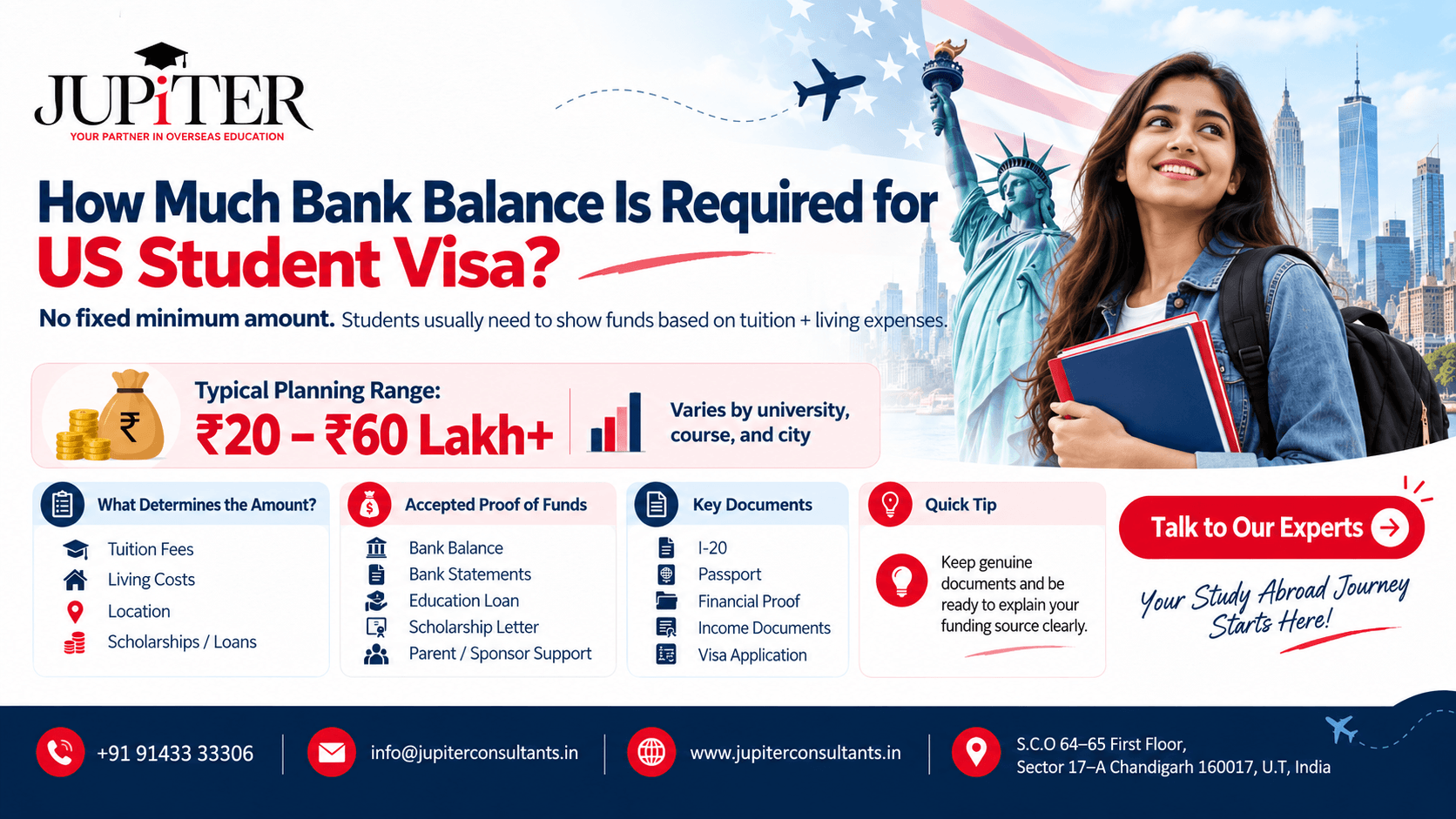
October 22, 2026 How much bank balance is required for a US student visa? There is no fixed minimum bank balance set by the US government for every F-1 student visa applicant. Generally, students need to demonstrate sufficient financial resources to cover their university’s estimated tuition, living expenses, and other relevant costs. The exact amount depends on the university, course, location, and available financial support.
Planning to study in the United States is exciting, but arranging financial documents can feel overwhelming. Many Indian students worry about whether ₹20 lakh, ₹30 lakh, or ₹50 lakh will be enough to secure their student visa.
The good news is that you don’t necessarily need an enormous bank balance. You need a realistic financial plan supported by genuine documents.
In this guide, Jupiter Consultant explains US student visa financial requirements, acceptable funding sources, bank statements, and practical ways to prepare for your visa interview.
Why Study in the US?
The US offers world-class education, globally recognized degrees, and excellent career opportunities. Students can benefit from scholarships, advanced learning facilities, and practical work experience through CPT and OPT programs, subject to eligibility.
What Is the Bank Balance Requirement for a US Student Visa?
The US student visa bank balance requirement refers to the financial resources an international student must demonstrate to support their education and living expenses in the United States.
For an F-1 visa, applicants must be able to explain how they will pay their educational, living, and travel costs. Universities also assess financial resources when issuing Form I-20.
There is no standard amount applicable to every student. Your university’s financial estimate is an important starting point.
How Much Bank Balance Is Required for an F-1 Visa in 2026?
The United States government does not set a single fixed minimum bank balance for an F-1 student visa. Instead, you must show enough liquid funds to cover at least the first year of tuition and living expenses as outlined on your university-issued Form I-20.
The amount depends mainly on your university’s tuition fees and estimated living expenses.
Here are illustrative annual budgets for different educational situations:
| University Category | Estimated Annual Expenses (USD) |
| Lower-cost public university | $25,000–$35,000 |
| Mid-range university | $35,000–$50,000 |
| Higher-cost private university | $50,000–$75,000+ |
These are planning examples, not official minimum financial requirements or verified fees for specific universities.
Students should use the estimated costs and funding information on their own Form I-20 rather than relying on general figures.
For example, if your university estimates annual expenses of $38,000, your financial documents should demonstrate how those expenses will be covered through eligible funding sources.
Latest Guidelines for Minimum Bank Balance for US Student Visa
There is no fixed minimum bank balance for a US student visa in 2026. Indian students may need approximately ₹20 lakh to ₹60 lakh or more, depending on university tuition fees and living expenses. Students must show sufficient funds through savings, education loans, scholarships, or sponsorship.
How Much Does It Cost to Study in the USA?
The cost of studying in the USA for international students typically ranges from $25,000 to $75,000+ per year, including tuition fees, accommodation, food, health insurance, and personal expenses. The total cost depends on the university, course, and location.
Estimated Cost of Studying in the USA in 2026
| Expense Category | Estimated Annual Cost (USD) |
| Tuition Fees | 15,000–50,000+ |
| Accommodation and Food | 8,000–18,000 |
| Health Insurance | 1,000–3,000 |
| Transportation and Personal Expenses | 1,000–4,000 |
| Total Estimated Cost | 25,000–75,000+ |
Note: These are approximate planning estimates, not fixed fees. Actual university costs may be higher or lower.
According to EducationUSA, actual expenses vary by institution and location. International students should check their university’s official cost estimate before preparing financial documents for the US student visa.
Financial Requirements Comparison for Other Countries
The student visa financial requirements in 2026 vary by country. Students planning to study abroad must show sufficient funds to cover living expenses, tuition fees, and other educational costs.
Student Visa Bank Balance Requirements in 2026
| Country | Required Financial Proof | Approx. Value in INR |
| USA | No fixed amount; depends on university | ₹20–60 lakh+ (illustrative budget) |
| Canada | CAD 23,448/year | ₹15.87 lakh |
| UK (London) | £13,761 for 9 months | ₹17.47 lakh |
| UK (Outside London) | £10,539 for 9 months | ₹13.38 lakh |
| Australia | AUD 29,710/year | ₹19.77 lakh |
| Germany | €11,904/year | ₹12.67 lakh |
How to Calculate the Required Bank Balance for a US Student Visa
Calculating your financial requirement is easier when you separate your expenses.
Step 1: Check Your University Tuition Fees
Tuition depends on the institution and program. Engineering, business, and specialized postgraduate courses may have different fee structures.
Step 2: Calculate Living Expenses
Consider accommodation, groceries, transportation, health insurance, and personal expenses.
Step 3: Identify Your Funding Sources
Subtract confirmed scholarships or university funding from the total expenses. Then identify how the remaining amount will be funded.
Example: Financial Planning for an Indian Student
Suppose a student receives admission to a US university with the following estimated annual expenses:
| Expense | Amount |
| Tuition Fees | $24,000 |
| Accommodation and Food | $12,000 |
| Insurance and other expenses | $3,000 |
| Total estimated expenses | $39,000 |
| Confirmed scholarship | $5,000 |
| Remaining funding requirement | $34,000 |
The student could potentially demonstrate the remaining amount through savings, an approved education loan, or documented family sponsorship, subject to the university’s requirements.
This calculation helps families avoid unnecessarily arranging funds without understanding the actual cost of education.
What Financial Documents Are Required for a US Student Visa?
Financial documents help establish that your education expenses can be supported.
Common supporting documents include:
- Bank statements: Recent statements showing available savings.
- Bank balance certificates: Official confirmation of available funds.
- Education loan sanction letters: Documents confirming approved educational financing.
- Scholarship letters: Evidence of awarded financial assistance.
- Sponsor documents: Financial evidence and support letters from parents or other sponsors.
- Income records: Salary slips, income tax returns, or business income evidence, where relevant.
- Fixed deposit certificates: Documents confirming accessible funds, subject to institutional requirements.
Not every applicant must submit every document. Universities and consular officers may request different evidence depending on the circumstances.
How Many Months of Bank Statements Are Required for a US Student Visa?
Many students ask whether three or six months of bank statements are sufficient.
There is no universal US government rule requiring every F-1 applicant to provide exactly three or six months of statements.
Some universities may request recent statements covering a particular period. Applicants should follow their university’s documentation requirements and prepare additional financial evidence if requested during the visa process.
Sudden large deposits may raise questions about the source of money. If your account includes a recent substantial transfer, keep genuine supporting documents explaining where the money came from.
Can Parents Sponsor a US Student Visa?
Yes. Parents and other eligible sponsors may help finance a student’s education.
For example, if a student’s father is paying the tuition fees, supporting evidence might include his bank statements, income documents, and a sponsorship letter.
Students should clearly explain their relationship with the sponsor and how the available funds will cover their expenses.
Can Education Loans and Scholarships Be Used?
Yes. Education loans and confirmed scholarships may form part of a student’s funding plan.
An approved loan sanction letter can support your application, while a scholarship letter may reduce the amount you need to demonstrate through personal or family savings.
However, a loan application that has not yet been approved is not equivalent to confirmed funding.
What Common Financial Mistakes Should Students Avoid?
Even students with sufficient funds can face difficulties if their financial information is unclear or inconsistent.
Avoid these common mistakes:
- Showing unexplained deposits: Maintain evidence of the source of recently transferred funds.
- Using inaccurate documents: Never submit altered bank statements or misleading financial information.
- Ignoring living expenses: Tuition is only one part of your education budget.
- Relying on unconfirmed loans: Obtain appropriate approval documents before claiming the loan as available funding.
- Providing inconsistent information: Ensure your sponsorship explanation, university documents, and financial records are accurate.
A well-organized financial file makes it easier to explain your funding arrangements confidently.
A Practical Example: Preparing Funds for a US Student Visa
Consider a hypothetical student named Aman from Chandigarh who receives admission to a US master’s program.
His university estimates annual expenses of $42,000. He receives a confirmed $7,000 scholarship, reducing the remaining estimated requirement to $35,000.
His family plans to cover this through documented savings and an approved education loan.
Instead of simply presenting an unexplained bank balance, Aman prepares a clear breakdown of tuition, expenses, scholarship funding, and family contributions.
This example shows why understanding the university’s actual financial requirements is more useful than following an arbitrary bank balance target.
This is an illustrative scenario, not a verified client testimonial or visa approval case.
Why Choose Jupiter Consultant for US Student Visa Guidance?
Preparing financial documentation while managing university applications can be stressful, especially when your family is investing significant savings in your future.
Jupiter Consultant provides overseas education guidance to students planning international studies.
According to its official website, the consultancy offers services including:
- University and course selection assistance.
- Student profile assessment and counselling.
- Education loan guidance.
- Application and documentation support.
- Visa interview preparation.
- Pre-departure and post-arrival assistance
The Jupiter website also displays a 4.6 Google rating based on 978 reviews, along with information about its experienced counselling team and international education support services.
These are published business trust signals, not a guarantee of admission or visa approval.
With guidance from Jupiter Consultant, students can better understand the documents and financial planning involved in preparing their applications.
Frequently Asked Questions About US Student Visa Bank Balance
Is ₹20 lakh enough for a US student visa?
It depends on the university’s estimated expenses and your other confirmed funding. ₹20 lakh may be sufficient in some circumstances but inadequate for higher-cost programs.
Is ₹30 lakh enough for an F-1 visa?
Possibly. Compare your total available funding with the estimated costs on your Form I-20. The balance alone does not determine visa eligibility.
Can I show a fixed deposit as proof of funds?
Fixed deposits may be accepted as financial evidence when funds are accessible and properly documented. Confirm the requirements with your university.
Do I need to show funds for the entire course?
Universities generally assess estimated expenses for an academic year or the program duration if shorter. Applicants should also be prepared to explain how they expect to finance the rest of their studies.
Can I use my father's bank account for a US student visa?
Yes. Parents commonly sponsor their children’s education. You should provide appropriate supporting financial and sponsorship documents when requested.
Can a US student visa be rejected due to insufficient funds?
Yes. If a consular officer is not satisfied that an applicant can finance their studies, that may affect the visa decision. Approval also depends on meeting other eligibility requirements.
Is a six-month bank statement compulsory?
No universal six-month requirement applies to every F-1 visa applicant. Follow your university’s specific instructions and be prepared to provide financial records requested by a consular officer.
Conclusion:
Understanding how much bank balance is required for a US student visa is an important step toward planning your education abroad.
There is no fixed minimum amount for all applicants. Your financial preparation should reflect the estimated costs of your chosen university, available scholarships, approved loans, and other legitimate funding sources.
Focus on genuine documentation, realistic budgeting, and a clear explanation of how you will finance your education.
Start Your US Study Journey With Jupiter Consultant
Your dream of studying in America deserves careful preparation. Don’t let confusion about bank statements, educational loans, or financial documents delay your university application.
Jupiter Consultant can help you understand the application process, review your documentation needs, and plan your next steps.

Book your counselling consultation early so you have adequate time to prepare before university and visa deadlines.

Amit Kaushal
Managing Director | Study Abroad & Student Visa Consultancy Expert
Amith Kaushal is the Managing Director of Jupiter Study Abroad Consultants Pvt. Ltd., Chandigarh, with over 12 years of experience in international education and study abroad consultancy. Since assuming leadership of Jupiter Consultants in 2014, he has been committed to helping students make informed decisions about their overseas education and future careers. Read More Read Less
With expertise in study abroad counselling, university admissions, course selection, student visa guidance and international education planning, Amith understands the opportunities and challenges students face when pursuing education overseas. His student-centric approach focuses on providing personalized guidance based on individual academic backgrounds, career aspirations and study destinations.
Amith holds a Bachelor of Commerce, an MBA in Marketing and a Diploma in Marketing from the Chartered Institute of Marketing (CIM), UK. His academic qualifications, combined with his industry experience, contribute to his understanding of student needs and international education pathways.
Under his leadership, Jupiter Consultants continues to guide aspiring students through important stages of their study abroad journey, from choosing suitable universities and courses to understanding admission and visa requirements.
Driven by a commitment to transparent guidance, informed decision-making and student success, Amith Kaushal remains focused on helping students pursue international education opportunities with clarity and confidence.